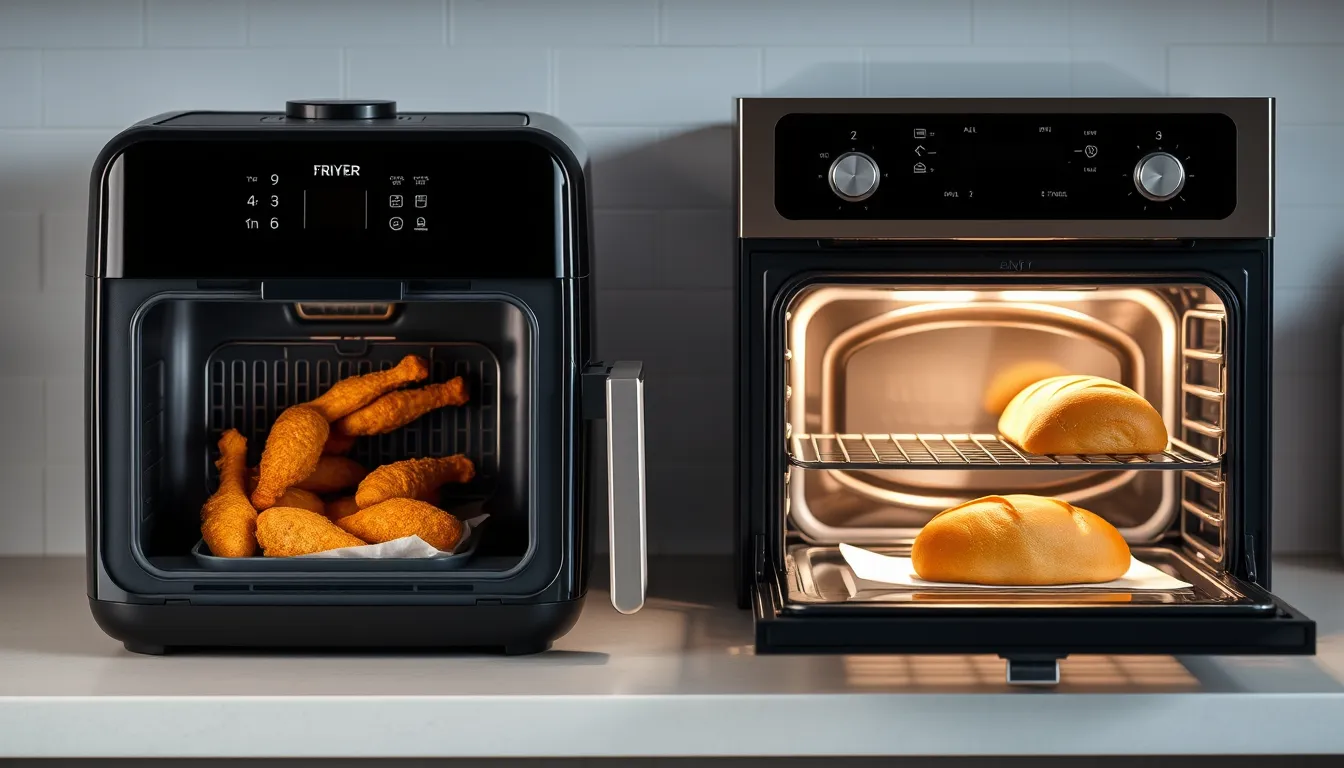
If you’re a home cook choosing between a countertop appliance and a full‑size oven, this guide cuts through the hype. Whether you feed one or a family of four, the choice depends on how each unit moves heat and handles volume.
You’ll learn how to compare air fryers and conventional ovens by examining convection versus radiant heat, the effect on batch cooking, and the real preheating time you’ll face. That insight lets you match the appliance to your routine with confidence.
Understanding the Core Difference: Convection vs. Radiation
The core distinction is the path heat takes to the food. In a conventional oven, electric or gas elements glow and emit radiant heat. That infrared energy travels in straight lines, heating the surface it strikes first; the interior of the food warms only as heat conducts inward.
Air fryers—and convection ovens—add a small, high‑speed fan. The heating element still produces hot air, but the fan creates convection: a constant stream of moving air that sweeps across every side of the food. This circulation reduces the thermal boundary layer, so heat transfers more quickly from the air to the food surface.
Because the air is constantly refreshed, moisture that evaporates from the food’s exterior is carried away rather than lingering. The result is a drier surface that browns and crisps faster, which is why air fryers excel at giving fries, wings, or vegetables a roasted crunch without a deep‑fat bath.
In contrast, radiant heat in a conventional oven can leave a thicker layer of steam on the food’s skin, slowing browning and often requiring longer cooking times or higher temperatures to achieve the same crispness.
Capacity and Batch Cooking: The Practical Limitation
One of the first things to notice when you learn how to compare air fryers and conventional ovens is the sheer difference in usable volume. An air fryer is a countertop appliance built around a single basket or tray; the interior dimensions are usually just enough for a few chicken pieces, a handful of fries, or a small batch of vegetables. That limited space means a whole turkey, a 2‑pound roast, or even two different side dishes cannot fit together.
A conventional oven, by contrast, is designed with multiple racks and a cavity that can accommodate several trays at once. The larger volume allows you to roast a big cut of meat on one rack while simultaneously baking a casserole on another, all under the same radiant heat environment.
The consequence for batch cooking is significant. For a family of four or more, an air fryer often requires you to run one or more cycles to finish a single meal—first the protein, then the vegetables, then perhaps a side. Each cycle adds a new preheat and cooking interval, eroding the time advantage that convection cooking normally provides.
When capacity is a priority, the conventional oven’s ability to handle larger portions in a single session usually outweighs the air fryer’s speed for small‑scale tasks.
Energy Efficiency and Preheating Times
The energy consumption of these appliances scales directly with the volume of air they must heat. A countertop air fryer occupies a fraction of the space taken by a standard conventional oven. Because the heating element only needs to warm a small chamber rather than an entire metal cavity, the wattage required to reach target temperatures is significantly lower for short-duration tasks. This makes the air fryer inherently more energy-efficient when preparing single servings or small snacks.
Preheating time further influences this efficiency. Air fryers typically reach operating temperature in just a few minutes, often eliminating the need for a dedicated preheat phase entirely. In contrast, conventional ovens require longer intervals to stabilize their internal temperature, consuming energy during periods when no food is being cooked.
However, efficiency per serving changes with meal size. If you are preparing a full family dinner, the oven’s ability to cook multiple trays simultaneously means the total energy cost is spread across more portions. In this scenario, the conventional oven becomes the more efficient choice, as running an air fryer in multiple batches would incur repeated startup costs and extend the total cooking time, potentially increasing overall energy usage despite the lower power draw of the smaller appliance.
Versatility: What Each Appliance Does Best
Choosing between these tools depends heavily on what you cook most often. An air fryer is a specialized countertop appliance designed for rapid, high-heat convection. It excels at transforming frozen foods, reheating leftovers, and cooking small cuts of meat like wings or tenders. The fast air circulation creates a crispy exterior without the need for deep frying, making it ideal for quick snacks and side dishes.
In contrast, a conventional oven relies on radiant heat and offers vastly more versatility for larger culinary projects. It is the only viable option for baking cakes, bread, and cookies, where even heat distribution is critical for proper rise and texture. Roasting a whole chicken, a turkey, or a large casserole requires the spacious interior and consistent temperature control that only a full-sized oven provides. If your meal plan involves cooking multiple dishes simultaneously, the oven’s capacity allows you to run a main course, a vegetable tray, and a dessert at once, saving significant time.
Some modern air fryers include grill or dehydrate functions, expanding their utility. However, these features remain limited by the appliance’s small footprint. You cannot dehydrate large quantities of fruit or grill a substantial steak effectively in a compact basket. For households that prioritize daily snack preparation and small portions, the air fryer suffices. For those who host gatherings or enjoy complex baking, the conventional oven remains indispensable due to its scale and functional range.
Space, Cleanup, and Kitchen Layout
Before buying, measure your available counter space. A countertop appliance like an air fryer occupies valuable real estate but offers flexibility. You can move it to a table or pantry when not in use. In contrast, a conventional oven is built-in, preserving counter space but requiring permanent installation. If your kitchen is compact, the portability of an air fryer might outweigh the space it consumes.
Cleanup is another significant factor. Air fryer baskets are typically removable and often dishwasher-safe, making maintenance quick and manageable. Oven racks and large trays, however, can accumulate grease and food residue over time, requiring more effort to clean. Frequent users of high-fat foods should consider this difference in maintenance routine.
Finally, consider noise. Air fryers rely on powerful fans to circulate hot air, which can create noticeable hums during operation. This may be disruptive in open-plan kitchens or small apartments. Conventional ovens, relying on radiant heat or slower convection, are generally quieter. If you cook while working from home or hosting guests, the sound profile of the appliance matters just as much as its cooking performance.
How to Decide Which One You Need
Start by auditing your actual cooking habits rather than idealized ones. If you live alone or as a couple and primarily prepare single or double portions, a countertop air fryer is often the superior choice. Its rapid preheating time and compact footprint make it efficient for quick, frequent meals without warming up the entire kitchen. You avoid the energy cost and wait time associated with heating a large, empty cavity.
For households with children or those who frequently host guests, a conventional oven remains essential. Batch cooking multiple dishes simultaneously is difficult in a small air fryer basket. If your routine involves roasting a whole chicken alongside vegetables and potatoes, the larger capacity of a standard oven is necessary.
Many households find the best balance by owning both appliances. However, if counter space is limited, consider a convection oven. This hybrid option utilizes a fan to circulate hot air, mimicking the crispness of an air fryer while retaining the capacity of a traditional oven. It offers a versatile middle ground for those who want speed and texture without sacrificing the ability to cook for groups. Evaluate your space, portion sizes, and frequency of large meals to determine which setup fits your daily routine.